
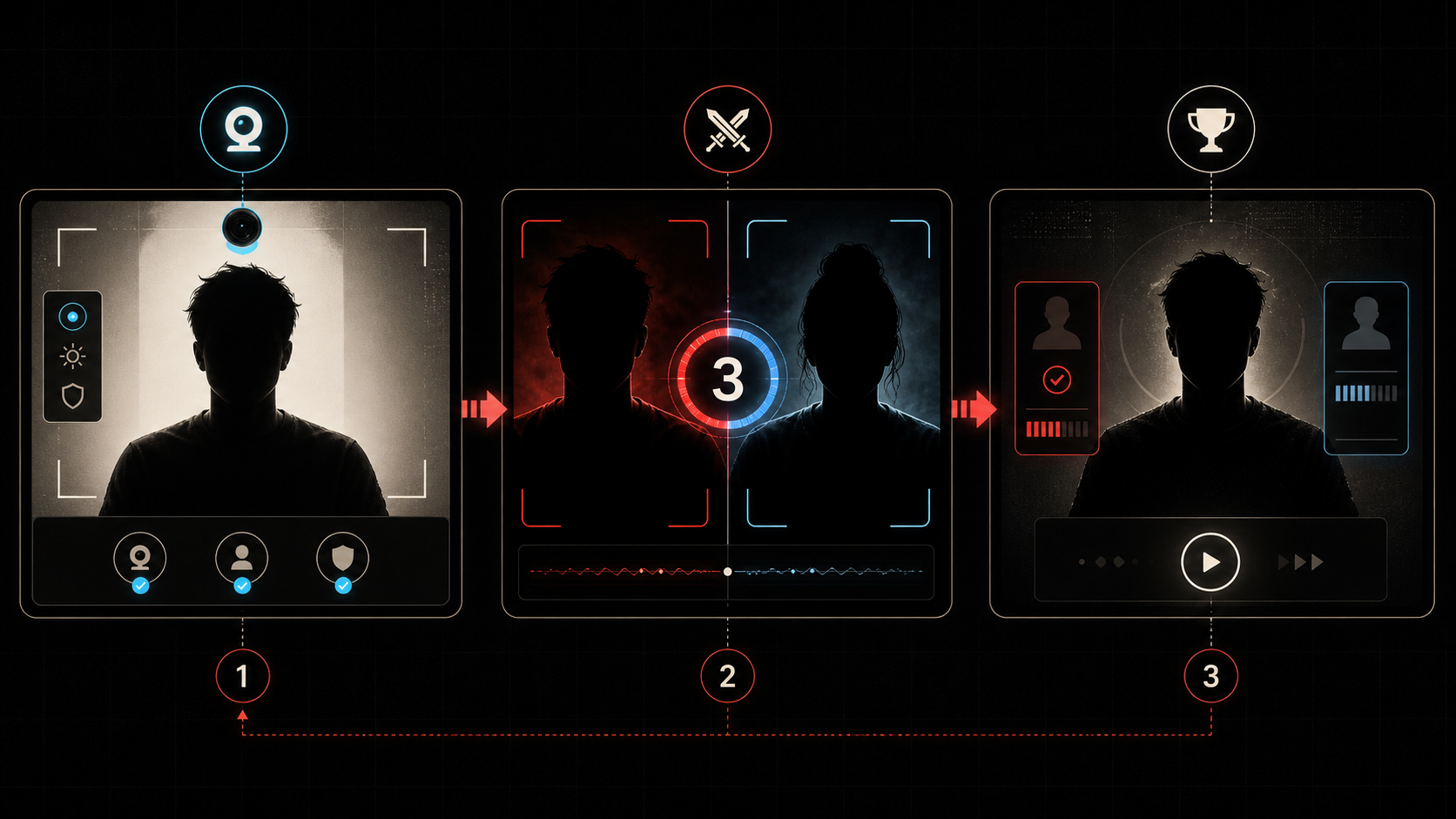
Omoggle works like a live 1v1 camera arena for adults. You enter the site, pass a camera and age gate, get matched with another user, appear on camera for a short round, and receive a result that may feed into rank, Elo-style score, match history, or leaderboard status.
The key idea is simple: Omoggle turns random video into a fast competitive face-off. It is not a private mirror, a dating app, or an objective attractiveness test. It is a live entertainment product with scoring mechanics and real privacy risk.
OmoggleMog is not affiliated with Omoggle. This guide is for adults, entertainment, and self-improvement. It does not predict real Omoggle Elo, promise wins, or provide an objective attractiveness diagnosis.
Last updated: May 12, 2026.
Quick Answer
Omoggle works by putting adults through a camera check, matching them into a short live 1v1 video round, then producing an in-app result that can affect score, rank, or leaderboard-style progression. The result is a game signal, not a scientific measurement of attractiveness or personal value.
The Basic Omoggle Flow
Most Omoggle sessions follow a tight loop:
- You open Omoggle.
- You acknowledge adult-only access and grant camera permission.
- The site checks that a live camera is present.
- You enter the arena queue.
- Omoggle matches you with another live user.
- Both users appear in a timed 1v1 round.
- The round produces a score, win, loss, draw, rank movement, or related result.
- You can leave, report, block, rematch, or queue again depending on the current product flow.
That is why Omoggle feels different from old random chat. The point is not a long conversation. The point is a short, scored camera moment.
Camera Check and Age Gate
Omoggle's public pages describe an adult-only arena with a camera access check before live play. The camera check is not the same as a government ID check. It is better understood as an access gate and anti-abuse step.
Before clicking through any camera prompt, check three things:
- You are on the domain you intended to visit.
- The browser camera permission prompt names that domain.
- You understand the current Omoggle Terms of Service and Privacy Policy.
If a page pushes you into a camera prompt before you understand what it is asking for, slow down. Random video is not the place to click on autopilot.
What Happens in the 1v1 Match
The match is the core of Omoggle. Two users appear live on camera. The product frames that moment as a face-off, not an open-ended chat room.
That means the first few seconds matter. Your camera angle, lighting, expression, background, and posture are doing work before you say anything.
| Match element | What it does | What you can control |
|---|---|---|
| Camera frame | Shows your face, room, posture, and light | Eye-level angle, soft front light, background |
| Countdown | Creates pressure before the first frame | Sit still, breathe, start neutral |
| Opponent | Gives the round its comparison context | Nothing, except whether you stay or leave |
| Result | Turns the round into a score or outcome | Your setup, not the whole scoring system |
| Rematch loop | Makes it easy to keep playing | Session length and stop rule |
You do not control the opponent. You do control whether your own frame looks prepared.
How Scoring and Ranking Probably Work
Public Omoggle copy describes ranking, Elo-style progression, match outcomes, and leaderboard mechanics. That does not mean outsiders can see the exact scoring formula.
Treat the score like a game result. It can be affected by:
- Opponent mix.
- Camera quality.
- Lighting.
- Expression timing.
- Network lag.
- Platform scoring rules.
- How the product currently handles wins, losses, and draws.
A score can be real inside the product without being a real-world verdict. That distinction matters. You can lose a match because the frame was bad, not because you are doomed.
What the Lab and Reports Are For
Omoggle pages also mention Lab-style reports and facial-analysis features. Based on public privacy language, these features are closer to in-product analysis and saved report mechanics than a permanent identity system.
For users, the practical point is this: read the current privacy policy before saving any report or granting camera access. Product behavior can change, and the exact data handling rules matter more than any clip you saw online.
If you only want to know whether your camera setup looks decent, a private warmup is a lower-exposure first step than jumping straight into the live arena.
Why the First Frame Matters So Much
Omoggle compresses social judgment into a tiny window. You do not get a profile, a bio, a long explanation, or a perfect photo edit. You get the first camera frame.
That is why basic setup changes can matter more than any hack:
- Raise the camera to eye level.
- Face soft light.
- Clean the visible background.
- Frame head and shoulders.
- Relax your mouth and shoulders.
- Prepare one short opener.
- Decide when you will leave.
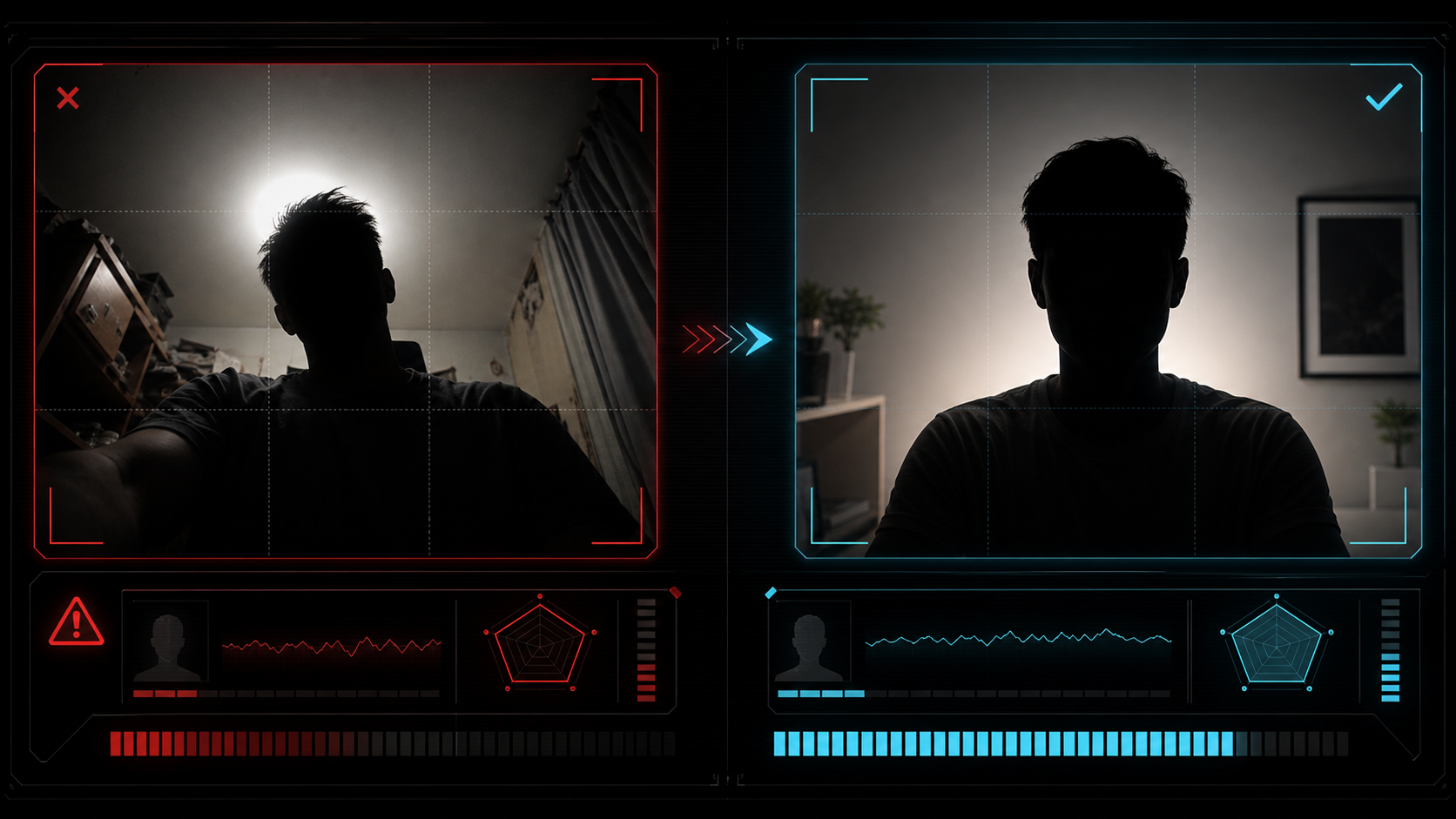
Most people do not need a secret strategy. They need to stop entering with bad light and panic posture.
What Omoggle Does Not Do for You
Omoggle does not make random video private. You are still on camera with a stranger.
Omoggle does not guarantee that the other user behaves well. Live video always carries risk.
Omoggle does not make a score objective. A number can look serious while still being noisy.
Omoggle does not remove your responsibility to keep personal information out of frame. Mail, IDs, screens, school names, badges, and windows can leak more than you think.
Pre-Match Checklist
Run this before you enter:
- You are 18+.
- You are on the correct Omoggle domain.
- You have read the current Terms and Privacy Policy.
- Camera is at eye level.
- Face is lit from the front.
- Background does not show private information.
- One short opener is ready.
- You know where leave, report, or block controls are.
- You have a stop rule before tilt starts.
- You understand the score is entertainment feedback.
If you fail the privacy lines, do not go live yet.
Related Omoggle Guides
Start with What Is Omoggle for the bigger product explainer. Read How to Play Omoggle if you want beginner steps. Use Is Omoggle Safe? before turning on the camera, and Is Omoggle Accurate? before taking a score too seriously.
FAQ
How does Omoggle work in simple terms?
Omoggle matches adults into short live 1v1 camera rounds. You pass a camera check, enter a match, appear on video with another user, receive an in-app result, and may see that result affect score, rank, or leaderboard-style progression.
Is Omoggle just random video chat?
No. Omoggle uses random live video, but it adds a competitive arena frame, scoring language, and ranking mechanics. It feels closer to a timed 1v1 face-off than an open-ended chat room.
Does Omoggle use real Elo?
Public Omoggle copy uses Elo-style ranking language, but outsiders should not assume they know the exact scoring formula. Treat the score as an in-product game signal, not a transparent chess-style rating.
What does the camera check do?
The camera check appears to confirm live camera access and support anti-abuse or entry gating. It is not the same as a government ID verification flow. Read the current Omoggle Terms and Privacy Policy before granting camera access.
Can I use Omoggle without being seen by strangers?
The live arena requires camera exposure to another user. If you want feedback without strangers seeing you, use a private warmup first. OmoggleMog is built for that lower-exposure preparation step.
Is OmoggleMog affiliated with Omoggle?
No. OmoggleMog is not affiliated with Omoggle. It is an independent private warmup and education tool for adults who want to test camera readiness before using public random video or arena-style services.