
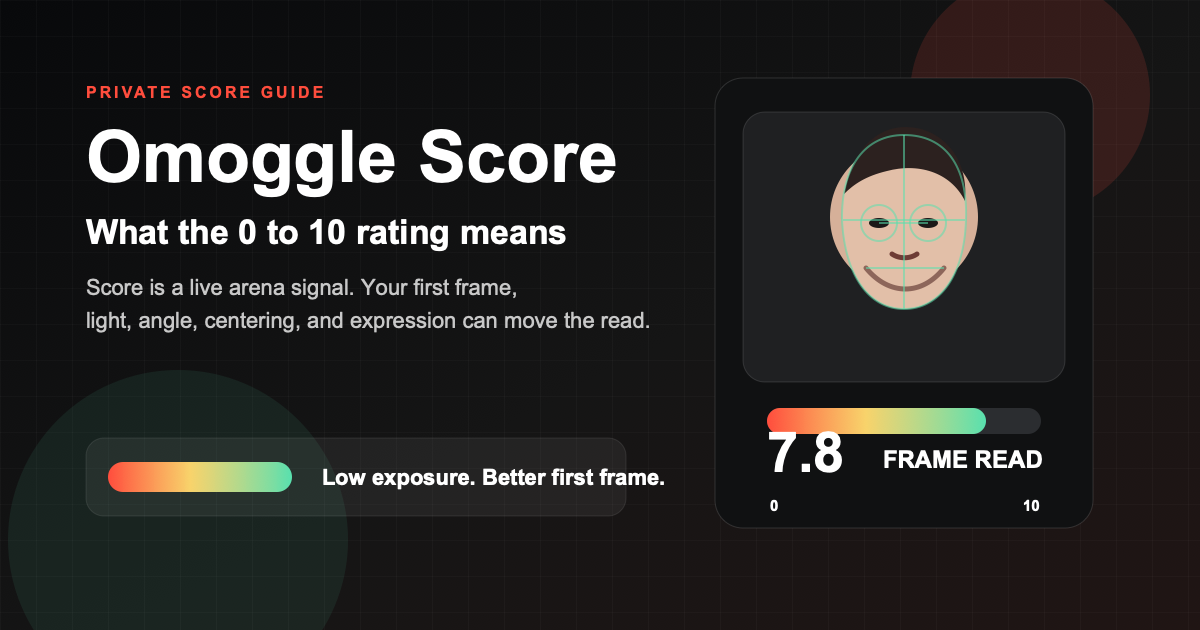
An Omoggle score is the 0 to 10 number shown after a live face duel. Public Omoggle pages describe a short camera round where face landmarks, scoring signals, and the opponent result feed into the final outcome. Treat the Omoggle score as an arena signal, not proof of attractiveness.
The useful question is "what did my camera frame make readable in that round?"
OmoggleMog is not affiliated with Omoggle. This guide is for adults 18+, entertainment, and camera-readiness education. It does not predict real Omoggle ELO, promise wins, or provide an objective attractiveness diagnosis.
Last updated: May 14, 2026.
Quick Answer
An Omoggle score is a 0 to 10 round rating from a live Omoggle duel. A higher Omoggle score usually wins the round, while ELO and rank track performance over time. The number can be affected by facial landmarks, lighting, camera angle, expression, frame quality, opponent mix, and platform rules.
Omoggle Score Ranges
Use the ranges below as a camera-readiness guide. They are not official identity labels, and they should never be used to judge your value.
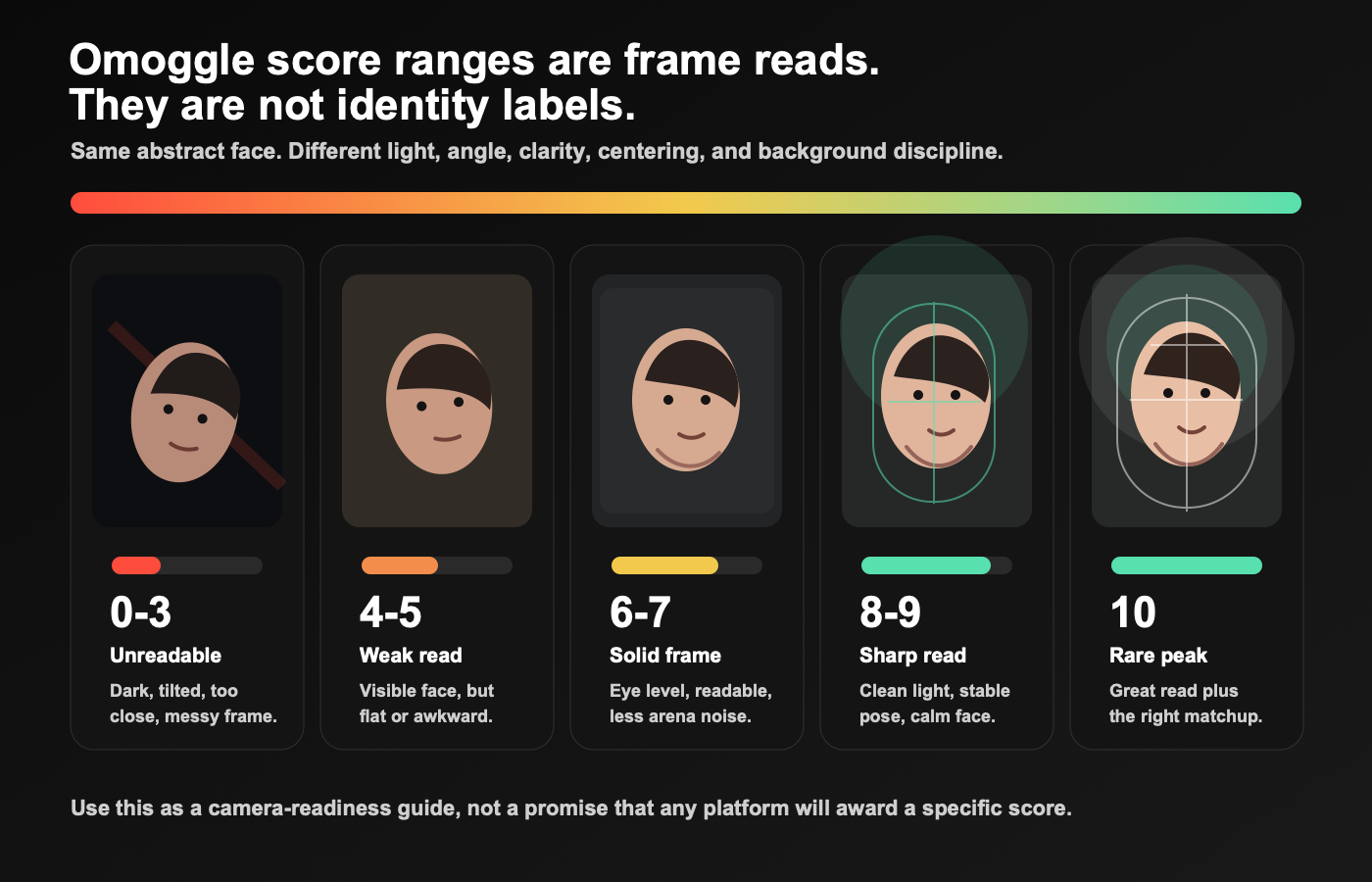
| Omoggle score range | What it usually signals | What to check first |
|---|---|---|
| 0 to 3 | The face read is weak or unreliable. | Darkness, blur, extreme angle, bad framing. |
| 4 to 5 | The face is visible but not strong. | Flat light, awkward posture, clutter. |
| 6 to 7 | The frame is solid and readable. | Small upgrades in light and expression. |
| 8 to 9 | The frame is sharp and controlled. | Consistency across multiple rounds. |
| 10 | A rare peak result. | Do not expect it every round. |
The same person can look worse or better depending on the first frame. A low Omoggle score can come from backlight, camera shake, a tilted laptop, a face too close to the lens, or a background that makes the whole frame feel chaotic.
That is why chasing a magic hack is the wrong move. Your first job is to make the input clean.
What Is a Good Omoggle Score?
A good Omoggle score is usually one that stays stable across multiple rounds, not one lucky spike. Consistency matters more if you care about rank, ELO, or leaderboard progress.
For most users, the first practical goal is not a 10. The first practical goal is to stop losing points to preventable frame problems.
Ask this after a round:
- Was my face centered and visible?
- Was the light in front?
- Was the camera near eye level?
- Did my first-second expression look calm?
If the answer is no, the Omoggle score may be reacting to presentation, not some deeper verdict.
Omoggle Score vs ELO vs Rank
The Omoggle score is the round number. ELO is the longer-term competitive rating. Rank is the tier or leaderboard position built from repeated results.
Public Omoggle pages say scores run from 0 to 10, higher score wins the duel, and ELO updates after the result. Other public pages describe local face mesh processing, 10-second rounds, and rank tiers such as Sub3, LTN, MTN, HTN, Chadlite, Chad, and Slayer.
One round can produce three different kinds of feedback:
| Signal | What it tells you | Why it can move |
|---|---|---|
| Omoggle score | How the round read your face. | Frame quality, timing, scoring rules. |
| ELO | How your wins and losses move. | Opponent strength and match result. |
| Rank | Where you sit in the ladder. | Many rounds, resets, active players. |
Do not confuse them. A decent Omoggle score can still lose if the other player scores higher. A rank tier can lag behind your current camera setup because it reflects history, not just the next frame.
What Can Move Your Omoggle Score?
You cannot control the full formula, the opponent pool, or the current platform tuning. You can control the camera input.
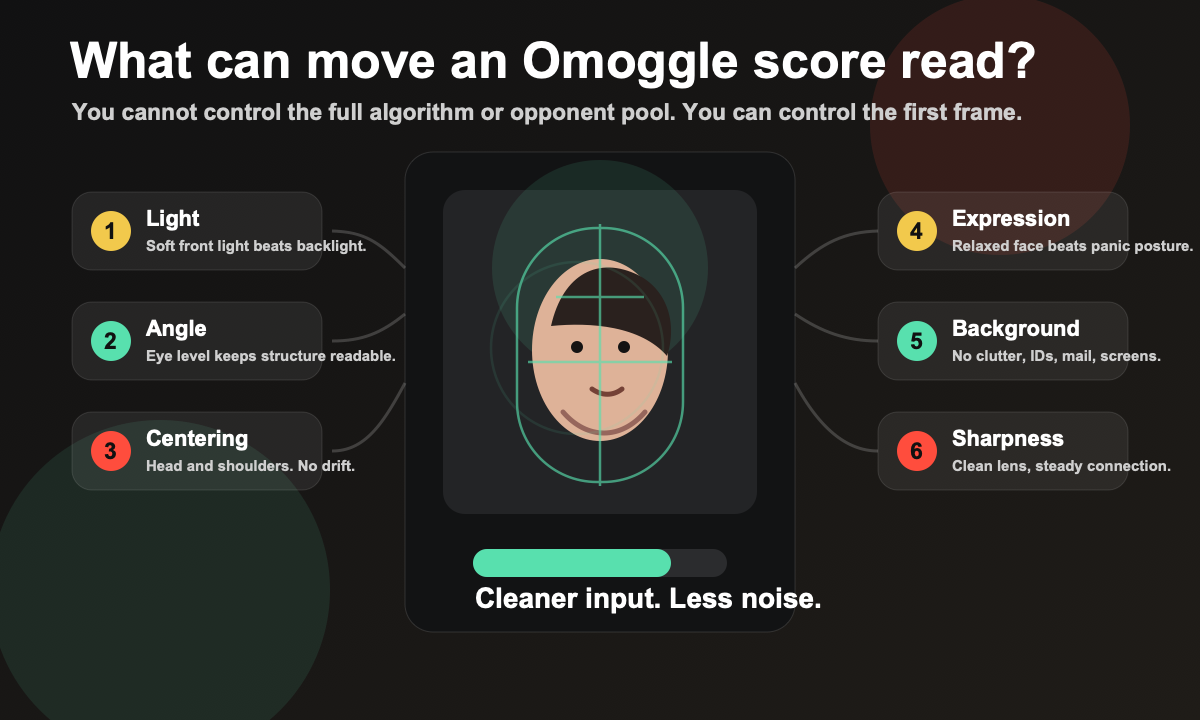
Start with these six factors:
- Light: face soft light from the front, not a bright window behind you.
- Angle: raise the camera to eye level so your face structure is readable.
- Centering: keep head and shoulders in frame without drifting.
- Expression: relax your mouth, jaw, and shoulders before the countdown.
- Background: remove IDs, mail, screens, clutter, and personal details.
- Sharpness: clean the lens, hold still, and use a stable connection.
These are not fake cheats. They are basic input hygiene. Cleaner input gives the Omoggle score less noise to fight through.
How to Improve an Omoggle Score Without Fake Hacks
Do a private setup pass before you queue. Put your phone or laptop at eye level. Face a soft light. Move private information out of the background. Keep head and shoulders visible. Take one neutral breath before the round begins.
Then test one change at a time. If you change light, angle, hair, expression, and background all at once, you will not know what helped.
Use this simple order:
- Fix light first.
- Fix angle second.
- Fix background third.
- Fix expression last.
- Repeat only if the frame still looks unstable.
The best Omoggle score prep is boring: clean input, steady posture, no panic face, no messy room.
Score Checklist Before You Go Live
Run this before the next duel:
- Face is lit from the front.
- Camera sits near eye level.
- Eyes, jaw, and mouth are clearly visible.
- Background has no personal information.
- Lens is clean and the image is sharp.
- You are not tilted, hunched, or too close.
- You know where leave, report, and block controls are.
- You understand the Omoggle score is entertainment feedback.
If you want lower exposure first, test privately before going live.
Related Omoggle Guides
Start with How Does Omoggle Work? for the full duel flow. Read Is Omoggle Accurate? before taking any number too seriously. Use How to Get a Good Ranking on Omoggle if you care about rank movement, and Is Omoggle Safe? before turning on the camera.
For official context, read Omoggle's public pages on scoring, duels, and ranks.
FAQ
What does an Omoggle score mean?
An Omoggle score is a 0 to 10 result from a live duel. It is a game signal based on the round, not a medical, psychological, or permanent attractiveness diagnosis.
What is a good Omoggle score?
A good Omoggle score is usually a stable score that stays solid across multiple rounds. One lucky high number matters less than a clean frame that keeps producing reliable results.
Can I improve my Omoggle score?
You can improve the controllable input: light, angle, centering, expression, background, and sharpness. You cannot guarantee a specific Omoggle score or force the platform to rank you higher.
Is Omoggle score the same as ELO?
No. The Omoggle score is the round rating. ELO moves after wins and losses. Rank is your broader ladder position after repeated matches.
Why did my Omoggle score drop?
Your Omoggle score can drop because of worse light, a bad angle, motion blur, a weak expression, poor connection, a strict quality gate, or simply a different round context.
Is OmoggleMog affiliated with Omoggle?
No. OmoggleMog is not affiliated with Omoggle. It is an independent private warmup and education tool for adults who want to test camera readiness before live random video or arena-style services.